Climate change is not a challenge for an uncertain future; it is an issue of today. The Conference of the Parties (COP), one of the most important platforms for international negotiations on addressing climate change, has brought together countries and stakeholders from around the world for more than three decades under the United Nations Framework Convention on Climate Change (UNFCCC). The 31st session of the Conference, COP31, will be held in Antalya, Türkiye, this November.
COP31 represents a critical milestone in discussions on how global climate goals can be translated into tangible action, investment and new models of collaboration.
For QNB Türkiye, COP31 is more than a summit taking place on specific dates. It represents an important reference point where new approaches to the future of the financial system, financing models and transition instruments converge around a common agenda. The journey towards COP31 also provides an important opportunity to explore the role climate finance can play in enabling this transformation from different perspectives.
On this dedicated COP31 page, we explore key topics shaping the journey towards the summit—from climate change adaptation and zero waste to the circular economy and transition finance for hard-to-abate sectors. Through the perspectives of Ömür Tan, CEO of QNB Türkiye, and Yeliz Ataay Arıkök, Co-Chair of the Sustainability Committee, together with blog articles and the latest COP31 developments, we examine these issues from different perspectives.
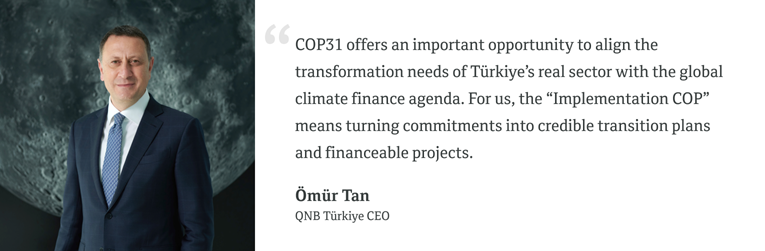
QNB Türkiye CEO Ömür Tan
COP31 presents an important opportunity to connect the transformation needs of Türkiye’s real economy with the global climate finance agenda. As global temperatures rapidly approach the 1.5°C threshold, one of the most pressing priorities today is to translate existing commitments into action. For us, an “Implementation COP” means turning these commitments into credible transition plans and financeable projects, while ensuring that progress is regularly monitored through clear and measurable indicators.
The responsibility of the financial sector in this process extends beyond providing financing for low-carbon investments. Supporting the transformation of emissions-intensive sectors and their capacity to adapt to climate change, contributing to the development of the necessary knowledge and awareness, strengthening access to information and finance, and contributing to long-term economic resilience are also important parts of this responsibility. Achieving this requires sector-specific targets, reliable data and a long-term approach to financing.
At QNB Türkiye, we support this approach through measurable targets and tangible actions. Through our Net-Zero Transition Plan, we set targets to support the transformation of priority sectors, integrate climate risks into our decision-making processes, and develop financing solutions aligned with our customers’ transition plans and investment needs. We leverage our financing capacity, sector expertise and international partnerships to accelerate the real economy’s low-carbon transition, strengthen climate resilience and support long-term competitiveness.
We also view ensuring that this transformation takes place on a more inclusive and equitable basis, particularly in terms of access to information and finance, as an integral part of the process.
The true impact of COP31 will be determined by the extent to which the decisions taken are translated into implementation, investment and measurable outcomes. We see COP31 as an important opportunity to develop new practices, strategies and partnerships that can accelerate Türkiye’s transition, and hope that it will serve as a powerful catalyst for amplifying the impact of this collective effort.
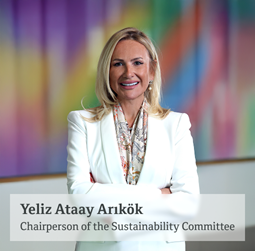
Chairperson of the Sustainability Committee Yeliz Ataay Arıkök
Yeliz Ataay Arıkök, Chairperson of the Sustainability Committee of QNB Türkiye’s Sustainability Committee, evaluates the climate finance agenda on the road to COP31.
As we approach COP31, the sustainability agenda highlights the need to address net-zero targets and climate resilience within the same strategic framework.
From the perspective of the financial sector, this means going beyond simply measuring and managing climate-related risks to directing capital towards credible transition plans, investments that strengthen climate resilience, and a just transition of the real economy.
As part of this journey, each month we will explore a different topic linked to the COP31 agenda from a climate finance perspective.
September | Circular Economy and Zero Waste Boost Competitiveness
The COP31 Presidency announced, as part of the Action Agenda, targets to halve the increase in global waste generation by 2035 and raise the global circular material utilization rate to at least 15 percent. Meanwhile, a draft regulation currently open for public comment in Türkiye proposes restrictions on the placing on the market of certain single-use plastic products. Why do these developments necessitate not only an environmental but also an economic transformation? How does QNB Türkiye define the role of finance in this transformation?
The zero-waste approach and the circular economy require a fundamental rethinking of production and consumption models—going beyond simply managing waste after it is generated. The linear production model increases pressure on natural resources while making companies more vulnerable to fluctuations in raw material prices, supply disruptions, and rising waste management costs. Designing products to be longer-lasting, repairable, reusable, and recyclable reduces resource use from the very beginning. Thus, the circular economy holds strategic importance not only for reducing pressure on nature but also for enabling companies to ensure resource security, manage costs, and maintain their long-term competitive strength.
The proposed restrictions on the marketing of certain single-use plastic products, as outlined in the draft regulation currently open for public comment in Türkiye, demonstrate that this transformation is becoming increasingly concrete for the business world. The goal here is not merely to replace a plastic product with another material. We are talking about a comprehensive transformation—from product design to raw material selection, from production lines to supply chain processes, and from reuse systems to recycling infrastructure. While this process creates compliance and investment needs for companies in light of new regulations, it also brings innovation, new business models, and market opportunities.
The measurable targets announced by the COP31 Presidency take the zero-waste and circular economy agenda beyond a mere environmental commitment, making it an integral part of the implementation and investment agenda. In the coming period, the primary need is for global targets to be translated into national policies, and for these policies to be transformed into feasible and scalable investments in the real sector. This transformation creates significant investment needs in areas such as resource-efficient technologies, circular production processes, reuse models, and recycling infrastructure. Implementing these investments is important not only for achieving environmental goals but also for enhancing the competitiveness of industry and ensuring secure access to resources.
Financing plays a crucial role in bringing technology, infrastructure, and process investments together with viable projects and in scaling these investments. As the financial sector, our responsibility extends beyond merely providing resources to also supporting the implementation and widespread adoption of these investments. At QNB Türkiye, we aim to contribute to the transformation of the real sector through our sustainable financing approach and international partnerships. Our priority is to develop financing solutions tailored to the needs of different sectors while evaluating the environmental and economic impacts of investments using measurable criteria and facilitating access to financing. We view supporting investments that enhance resource efficiency, keep materials in the economic cycle longer, and promote circular business models as a key component of boosting companies’ long-term competitiveness.
August | Financing Climate Change Adaptation
At COP30, a call was made to at least triple adaptation finance for developing countries by 2035, while the Belém Adaptation Indicators were adopted to track progress under the Global Goal on Adaptation.Why is translating these decisions into implementation critical on the road to COP31? How does QNB Türkiye assess the role of the financial sector in strengthening the climate resilience of the private sector?
The impacts of climate change are no longer solely environmental; they are creating direct economic and financial risks. Extreme weather events such as droughts, floods, wildfires and heatwaves are affecting a wide range of areas, from production capacity and supply chains to infrastructure and agriculture. While efforts to reduce emissions remain critical, preparing the economy for increasingly unavoidable climate impacts and strengthening its resilience are becoming increasingly important.
The call at COP30 to scale up adaptation finance highlighted the scale of financing needs in this area, while the Belém Adaptation Indicators provide an important common framework for tracking progress in a more systematic and measurable way.
As we move towards COP31, the key challenge is to turn this ambition into effective implementation mechanisms. This requires not only increasing resources, but also properly assessing climate risks, identifying priority investment areas and directing finance towards projects that can be implemented. Making effective use of public resources to mobilise private capital and developing risk-sharing mechanisms are also important components of this process.
From an adaptation finance perspective, we believe the priority should be to accelerate investments that reduce the vulnerability of companies and the economy to climate impacts.
Investments in water and energy efficiency, climate-resilient infrastructure, early-warning and risk-management systems, sustainable agricultural practices, and business continuity are emerging as key areas. Financing directed towards resilience and adaptation today reduces potential future losses while also protecting companies’ competitiveness and capacity to create long-term value.
At QNB Türkiye, we place importance on integrating climate risks into our financing decisions, supporting companies in accurately identifying the risks they face and their investment needs, and developing long-term financing solutions tailored to these needs.
We believe the financial sector can play a critical bridging role by leveraging its risk assessment capabilities, sector expertise and financing instruments to translate adaptation objectives into financeable investments and direct capital towards areas that will strengthen the resilience of the economy.
Explore Our Latest COP31 News
Explore All Our COP31 Blog Posts
